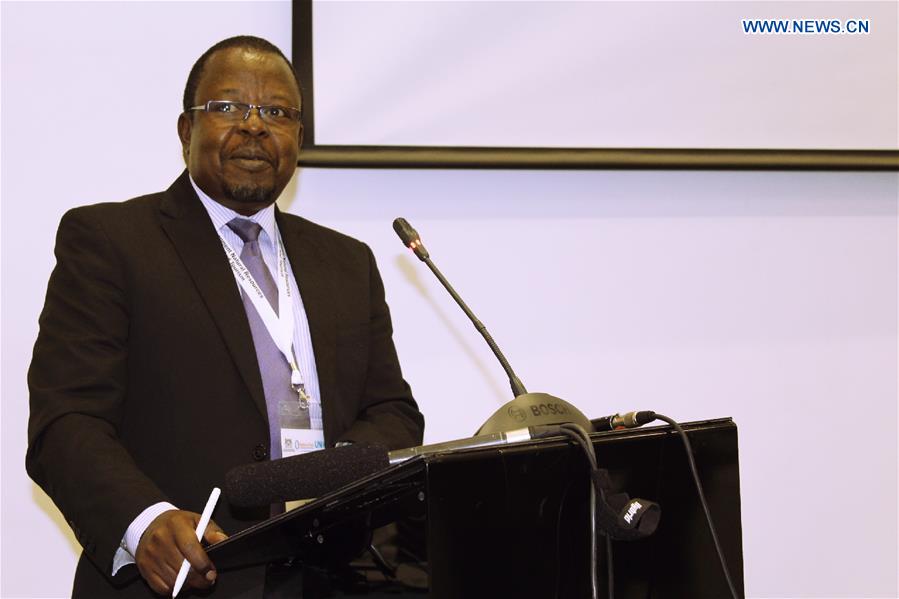
Frank Turyatunga, the Deputy Regional Director, Africa Office, UN Environment, speaks at the Joint Network and Thematic Meetings of the National Ozone Officers of the 54 African countries in Gaborone, capital of Botswana, on May 21, 2018. The United Nation (UN) Environment, Africa office has applauded Africa's 54 countries for their efforts to phase out CFCs and Halons among others, which were some of the most widely used ozone-depleting substances. (Xinhua/Sharon Tshipa)
GABORONE, May 21 (Xinhua) -- The United Nation (UN) Environment, Africa office has applauded Africa's 54 countries for their efforts to phase out CFCs and Halons among others, which were some of the most widely used ozone-depleting substances.
Speaking at the Joint Network and Thematic Meetings of the National Ozone Officers of the 54 African countries, which commenced on Monday, in Gaborone, the capital of Botswana, Frank Turyatunga, the Deputy Regional Director, Africa Office, UN Environment, said the total emissions that will ultimately be avoided as a result of phasing-down HFCs - as well as the extent to which other sustainable development co-benefits can be secured - will depend on the choices countries make about key issues.
Africa's efforts to phase out CFCs and Halons followed the 16th session of the African Ministerial Conference on the Environment (AMCEN), which welcomed the Kigali Amendment to the Montreal Protocol on Substances that Deplete the Ozone Layer.
The protocol adopted in Kigali on Oct.15, 2016 at the 28th Meeting of the Parties to the Montreal Protocol, included a commitment to reduce the production and consumption of hydrofluorocarbons by more than 80 percent over the next 30 years in order to reduce greenhouse gases.
According to the 2016 consumption data that Botswana submitted to Ozone Secretariat, the country has already achieved the 10 percent HCFC reduction and it is expected that by continuing with the ongoing activities the country will also achieve the 35 percent reduction by 2020 in line with the phasedown schedule.
In order to reduce greenhouse gases effectively in the next 30 years, Frank Turyatunga called on all member states who have not yet ratified the Kigali Amendment to the Montreal Protocol on Substances that Deplete the Ozone Layer, to do so as soon as possible.
He said they should do this bearing in mind that universal participation is necessary to ensure the protection of both the ozone layer and the climate.
Without a healthy ozone layer, all life on earth would be negatively impacted by ultraviolet radiation from the sun. Skin cancer, cataracts, and threats to plant growth and food chains are just some of the effects said to cause by high exposure to ultraviolet radiation.