
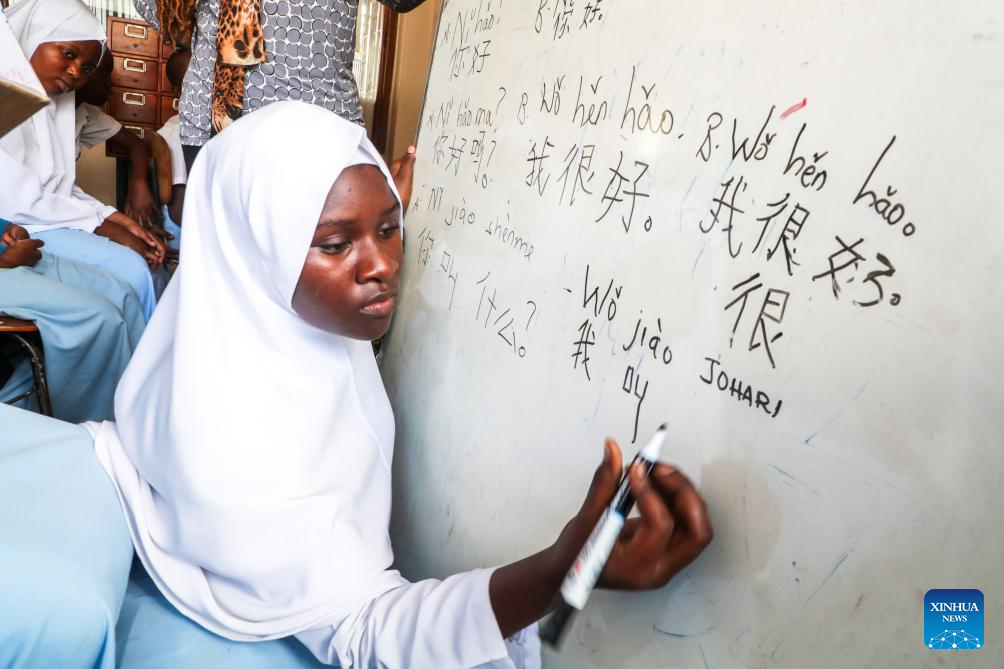
A student writes on the whiteboard in a Chinese language class at Zanaki Secondary School in Dar es Salaam, Tanzania, April 15, 2026. (Xinhua/Emmanuel Herman)
DAR ES SALAAM, April 19 (Xinhua) -- In a classroom at Zanaki Secondary School, a government-owned girls' school in Tanzania's Dar es Salaam, 13-year-old Rosemary Thadei Mushi stands among her peers, carefully guiding them through the tonal subtleties of Mandarin Chinese.
Across the campus, students are increasingly embracing Chinese not merely as an academic subject, but as a pathway to future opportunities. As the world prepares to mark Chinese Language Day, the enthusiasm among students reflects a broader trend across Africa, where interest in learning Mandarin continues to grow.
For Rosemary, a Form One student, studying Chinese has already begun to reshape her perspective. Beyond mastering characters and pronunciation, she has developed a more nuanced understanding of Chinese culture and people. Aspiring to become a doctor, she believes proficiency in the language could help her secure a scholarship to study abroad and broaden her horizons.
She also challenges common perceptions. What some describe as a "strict" sound, she says, often reflects tonal complexity rather than temperament. Her own experience has revealed something different -- a culture she describes as warm and considerate.
Fifteen-year-old Koletha Fikiri Mtakuja shares a similar vision. A Form Three student with ambitions in engineering, she views Mandarin as a gateway to accessing China's technological advancements.
"China is very advanced in science and technology," Koletha said. "Knowing Chinese will help me learn directly from their engineers."
Both students dream of visiting China, hoping to walk along the Great Wall in Beijing and experience firsthand the traditions and rapid development they currently encounter through digital platforms, music, and films.
Their ambitions align with a broader global movement. Observed annually on April 20, Chinese Language Day was established by the United Nations to promote multilingualism and the equal use of its six official languages. In recent years, the day has also come to symbolize the growing educational and economic ties between China and Africa.
Behind the students' progress stands their teacher, Ema Silagomi, one of Tanzania's pioneering Chinese language educators.
Motivated by a passion for languages, she trained in China between 2018 and 2019 under a joint program by the Tanzanian and Chinese governments, studying at Zhengzhou University of Aeronautics and Henan University, where she gained both language skills and teaching methodologies.
Upon returning to Tanzania as one of the first local Chinese language teachers, Silagomi faced the challenge of building the program from scratch. Despite limited teaching materials and the absence of immersive language environments, she remained committed to expanding access to Chinese language education.
"I saw the opportunities in China regarding education, business, and cultural exchange, and I wanted Tanzanian youth to benefit," Silagomi explained. "It is a language full of opportunities." ■

Schoolgirls take a Chinese language class at Zanaki Secondary School in Dar es Salaam, Tanzania, April 15, 2026. (Xinhua/Emmanuel Herman)

A student writes on the whiteboard in a Chinese language class at Zanaki Secondary School in Dar es Salaam, Tanzania, April 15, 2026. (Xinhua/Emmanuel Herman)

Schoolgirls take a Chinese language class at Zanaki Secondary School in Dar es Salaam, Tanzania, April 15, 2026. (Xinhua/Emmanuel Herman)