Economic Watch: AI powers smarter manufacturing at FAW-Volkswagen's Tianjin factory

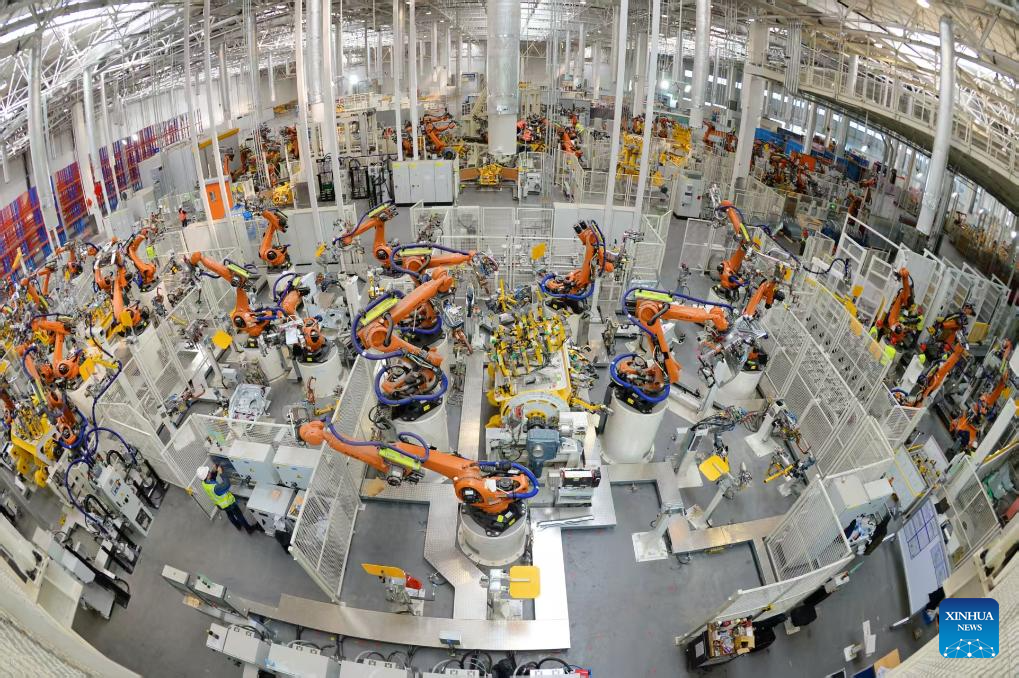
This undated file photo provided by the interviewee shows a view inside a general assembly workshop of the FAW-Volkswagen's Tianjin factory in north China's Tianjin. (Xinhua)
TIANJIN, June 3 (Xinhua) -- Robotic arms swing rapidly as auto parts are precisely grabbed, flipped and welded. Automated guided vehicles (AGVs) shuttle across the workshop, delivering materials to designated stations. On giant digital screens, real-time data on equipment operation, energy consumption and quality control keep flashing.
Inside FAW-Volkswagen's Tianjin factory in north China, the roar and bustle of a traditional manufacturing plant are being reshaped by a smart industrial system powered by artificial intelligence.
Located in the Tianjin Economic-Technological Development Area, the factory boasts a total investment of 19.5 billion yuan (about 2.9 billion U.S. dollars). Covering 1.08 million square meters, it has a planned annual production capacity of 240,000 vehicles.
Construction began in 2016, and it took only 23 months for the first batch of vehicles to roll off the production line, setting a record as Volkswagen Group's fastest-built factory worldwide.
Today, this factory is undergoing a new round of transformation toward an AI-powered smart factory.
According to a 2026 industry report by the China Academy of Information and Communications Technology, new AI technologies, including large models, AI agents and embodied intelligence, are rapidly integrating into manufacturing systems, reshaping industrial production and creating major opportunities for China's manufacturing upgrade.
Traditional automobile manufacturing relied heavily on human experience: production scheduling based on manual judgment, quality inspection through visual checks, and equipment maintenance carried out at fixed intervals, said Marek Smykal, general manager of FAW-Volkswagen Tianjin branch.
"AI is fundamentally changing this decades-old production model, making the entire process smarter, more efficient and more precise," Smykal added.
So far, the Tianjin branch has developed 105 high-value smart manufacturing application scenarios, covering stamping, welding, painting and final assembly.
In the stamping workshop, AI-powered scheduling systems automatically adjust production rhythms based on order requirements and equipment status. Vision inspection systems perform millimeter-level inspections of components, while predictive maintenance systems use IoT data to identify equipment abnormalities before breakdowns occur. The intelligent upgrades in the stamping workshop alone have saved more than 3,000 man-hours.
In the welding workshop, visual inspection systems can automatically identify gluing defects, while smart energy management systems dynamically optimize energy consumption based on production loads.
In the assembly workshop, technologies such as AI visual recognition, robotic guidance and smart picking are also continuously improving production efficiency.
Company data show that the factory's intelligent upgrades have increased overall production efficiency by 16 percent, reduced quality-related issues by 20 percent, and saved 8.52 million yuan in costs.
"Whether in supply chain coordination, quality management or green manufacturing, we hope AI can create greater value across more production processes and further improve the factory's efficiency, flexibility and sustainability," Smykal said.
As the auto industry accelerates toward electrification and intelligent transformation, the Tianjin factory is also advancing upgrades in intelligent driving, smart cockpits and connected-vehicle technologies.
Looking ahead, Smykal said that "consumers are looking for more than just a means of transport. They want smarter and more convenient mobility spaces."
At the 2026 World Intelligence Expo in Tianjin, FAW-Volkswagen Tianjin branch showcased its latest achievements in automobiles, artificial intelligence and smart manufacturing.
The company's smart factory exhibition featured multiple intelligent manufacturing scenarios, including visual inspection technologies, predictive equipment maintenance and smart energy management systems.
Meanwhile, the factory is pursuing a diversified strategy covering gasoline, electric and hybrid vehicles.
"The Tianjin factory will continue to drive innovation through advanced technologies, deepen smart manufacturing, and accelerate its transition toward new energy vehicles," said Hao Yanfei, deputy Party secretary of FAW-Volkswagen Tianjin branch. ■


