Xizang Story: Information engineer preserving Tibetan language in digital era

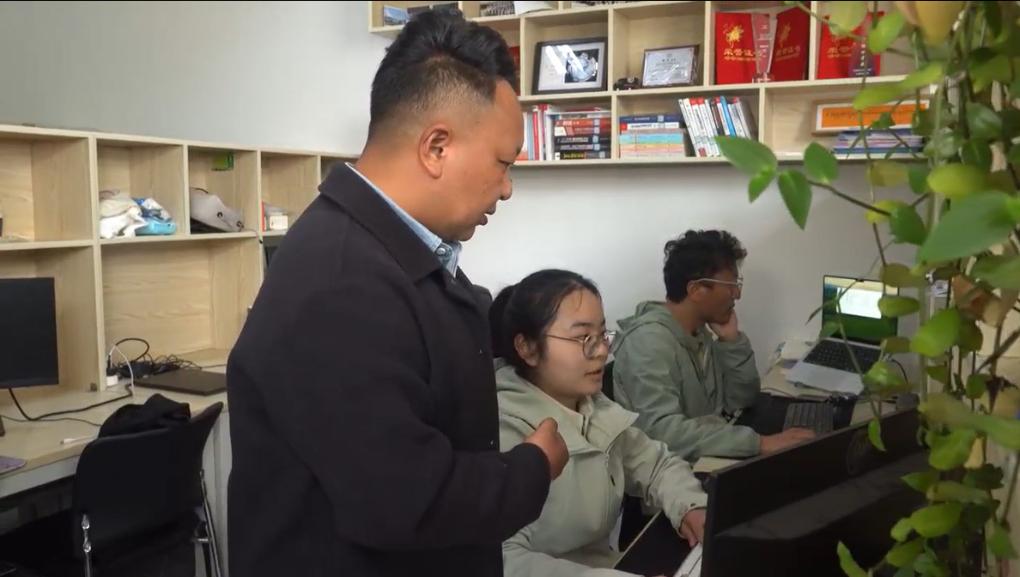
Lhakpa Dondrup instructs students at a laboratory in Xizang University in Lhasa, southwest China's Xizang Autonomous Region, April 9, 2026. (Xizang University/Handout via Xinhua)
LHASA, May 20 (Xinhua) -- In a university laboratory in southwest China's Xizang Autonomous Region, Lhakpa Dondrup read a passage in his native dialect into the microphone. Almost instantly, Tibetan writings showed up on the screen.
With a click, the system read the text back in natural-sounding Tibetan via a recently developed text-to-speech feature integrated on the same interface.
"A 95 percent recognition accuracy rate covering all three Tibetan major dialects means that Tibetan herders and farmers can chat and search for information in their mother tongue on their phones," said the 35-year-old Tibetan.
Lhakpa Dondrup, an associate professor at the school of information science and technology, Xizang University, is one of the 57 faculty members engaged in information science and technology at the university.
Lhakpa Dondrup is among the talents contributing to the language's digitization on the plateau, with government backing to preserve and promote the Tibetan language.
Born into a farming family in the rural area of Xizang's Xigaze City, Lhakpa Dondrup first encountered a computer in 2007 during an IT class in high school.
"Staring at my teacher's computer, I leaned in so close that the tip of my nose nearly touched the screen," he recalled. "I found the little magical box could hold the whole world inside."
That sense of wonder, in the years to come, drew him deep into the interwoven world of Tibetan script and computing.
Three years later, Lhakpa Dondrup was enrolled in the Tibetan language information technology research center at Xizang University, majoring in computer science and technology.
While participating in an academic competition during his sophomore year, Lhakpa Dondrup developed a Tibetan language learning software, allowing users to memorize Tibetan vocabulary through mini-games. Featuring Tibetan characters with clickable pronunciation, the program became his first project related to Tibetan language information processing.
It was then that he realized that a computer is not just a "magical box," but can become a tool for protecting his mother tongue.
Now, Lhakpa Dondrup leads a team in developing several computer programs of Tibetan voice recognition, synthesis and translation, which have been put into use in cooperation with three local information technology companies.
He has also helped record online coursework for Tibetan language information processing, the first of its kind in China, and traveled to more than 20 countries and regions for academic conferences.
This year, Lhakpa Dondrup received the title of "New Era Youth Pioneer," a national honor for young Chinese who have made outstanding contributions in their fields.
China has been supporting Tibetan language informatization. At the end of 2015, the national standard "Information Technology -- Vocabulary" in Tibetan was officially released, becoming the country's first national standard vocabulary for information technology in an ethnic-minority language. In 2023, an online platform to deal with queries concerning Tibetan and Mandarin was launched, hosting a database of 300,000 standard terms, according to a white paper released last year.
DeepZang, China's first Tibetan-language large language model, was introduced in Lhasa in March this year. It supports intelligent interaction in Tibetan, Mandarin and English, and integrates AI conversations, real-time translation and speech-to-text transcription.
Beyond research and teaching, Lhakpa Dondrup is a father of two children. His nine-year-old daughter, Tenzin Kunkyi, often leaned over his computer, watching the Tibetan script dance across the screen, and asked, "Can the Tibetan on the screen travel really far?"
The kid's curiosity has become a source of courage for Lhakpa Dondrup whenever code fails or his thought process hits a dead end.
"What I am doing is not just technology but preserving the roots and voice of a culture for the younger generation," he said. ■

Lhakpa Dondrup attends an academic conference in Nanning, south China's Guangxi Zhuang Autonomous Region, Feb. 22, 2025. (Xizang University/Handout via Xinhua)


